If you’ve ever opened a jar of fermented veggies to find mushy carrots or a questionable film on top, you’re not alone. Failures—real or perceived—are part of becoming a skilled fermenter.
Start Here: Most “Failures” Are Teachable Moments
This guide walks through common problems, their causes, and specific fixes. Think of it as a troubleshooting chart with explanations so you understand what went wrong and how to confidently adjust next time.
Problem 1: Mushy or Slimy Vegetables
How It Looks
- Carrots bend instead of snap.
- Cucumber spears feel “cooked” or mushy.
- Brine feels thick, slick, or “ropy” between your fingers.
What’s Usually Happening
Mushiness comes from cell walls breaking down, often because of:
- Too warm temperatures for too long
- Too little salt
- Enzymes from the vegetables or microbes that degrade pectin
Sliminess (“ropy” brine) usually signals unwanted bacteria dominating.
How to Respond
- Mushy but not slimy: Still often edible and safe if aroma and flavor are normal. Use in soups, stews, or blender sauces.
- Slimy/ropy: Discard. Do not try to rescue.
How to Prevent It Next Time
- Use enough salt. Aim for at least 2% of total veggie weight.
- Shorten room‑temperature time. In warm weather, move jars to the fridge as soon as they taste pleasantly sour.
- Choose the right vegetables. Very overripe or limp produce breaks down faster.
For cucumbers:
- Use small, firm pickling cucumbers. - Remove blossom ends (they contain softening enzymes).
Problem 2: Mold on the Surface
How It Looks
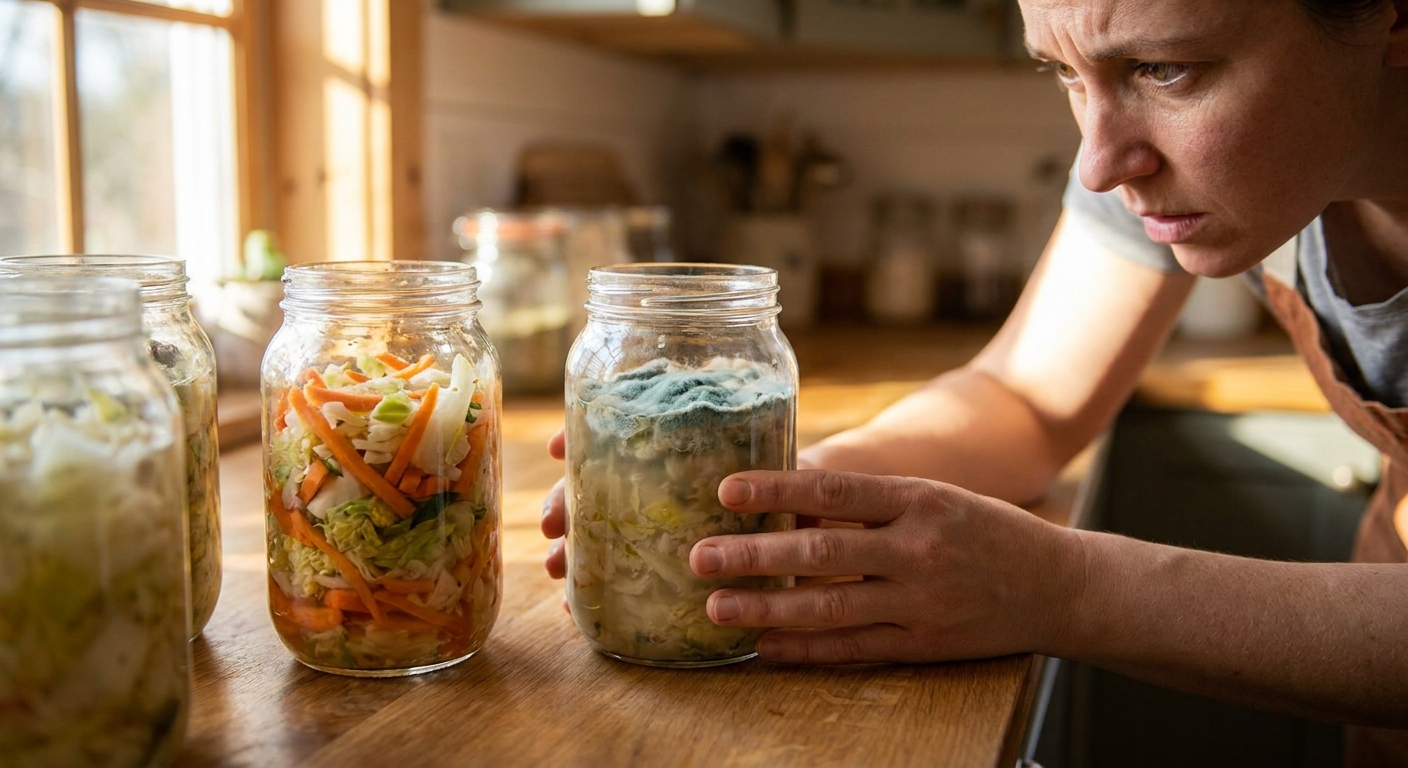
- Fuzzy spots or patches (blue, green, black, or pink).
- Sometimes starts as small dots and spreads.
What’s Usually Happening
Molds are aerobic fungi—they need oxygen. Mold growth usually means:
- Something is poking out of the brine.
- There’s a large air pocket at the top of the jar.
- The jar sat undisturbed in a warm spot for a long time.
How to Respond
- If the mold is thin, newly formed, and very localized, experienced fermenters sometimes scrape away the top few centimeters and keep the rest.
- For beginners or in case of doubt: discard the batch. Safety matters more than saving one jar.
How to Prevent It Next Time
- Keep vegetables fully submerged. Use:
- Glass or ceramic weights
- A smaller jar inside a bigger one
- A brine‑filled zip‑top bag as a weight
- Limit headspace. Fill jars so there’s only 2–3 cm (about 1 inch) between brine and lid.
- Avoid surface flavorings. Don’t let herbs, garlic, or spices float on top.
Problem 3: White Film (Kahm Yeast)
How It Looks
- Thin, matte, white film on the surface of the brine.
- Not fuzzy or hairy.
- May wrinkle slightly when disturbed.
What’s Usually Happening
Kahm yeast are wild yeasts that thrive on oxygen at the surface. They’re generally not dangerous, but they can:
- Make brine smell slightly off
- Add a bitter or funky note if allowed to grow thick
How to Respond
- Gently skim off the yeast with a clean spoon.
Smell and taste:
- If aroma is pleasantly sour and flavor is good, the ferment is fine. - If it tastes harsh, bitter, or oddly “chemical,” consider discarding.
How to Prevent It Next Time
- Improve submersion and oxygen control.
- Use an airlock lid or at least a well‑fitting lid slightly loosened.
- Start with a slightly higher salt level (2.5–3%) in very warm weather.
Problem 4: No Bubbles, No Cloudiness, No Sourness
How It Looks
- Brine stays clear.
- No visible bubbles even after a week.
- Vegetables taste just salty, not tangy.
What’s Usually Happening
Fermentation is slow or stalled because:
- The environment is too cold.
- There’s too much salt.
- Microbial starting population was low (over‑washed or very old produce).
How to Respond
- If you’re at cool room temp (15–18°C / 59–64°F), give it more time—up to 2 weeks.
- If nothing changes after 10–14 days at normal room temp (18–22°C / 64–72°F):
- Taste: if it’s just salty and not sour, and there’s no off odor, you can keep waiting a bit longer.
- If off smells develop without sourness, discard.
How to Prevent It Next Time
- Check your salt math. For 1 kg veggies, use 20–25 g salt (2–2.5%).
- Use fresh, unpeeled produce when possible. Avoid heavily chlorinated water; if in doubt, use filtered water.
- Ferment at room temperature, not in a fridge, for the active phase.
Problem 5: Strong, Unpleasant Smells
How It Smells
- Rotten eggs
- Fecal or “sewer” odor
- Sharp chemical or solvent‑like scent
What’s Usually Happening
Some smells are normal, especially with cruciferous vegetables (cabbage, radish, turnip). But truly foul, putrid, or solventy smells indicate unwanted microbes outcompeting LAB.
How to Respond
- If your instinct says “no”, trust it. Discard.
- Don’t overanalyze a jar that makes you recoil.
How to Prevent It Next Time
- Clean, not sterile: Wash jars and tools well, but no need to boil.
- Right salt, right temp: 2–3% salt, and avoid overly warm spaces if possible.
- Submerge thoroughly: Exposed bits rot and can taint the entire jar.
Remember: Strong garlic, radish, or cabbage smells can be intense but still safe and tasty. You’ll learn to distinguish “bold but good” from “truly off” with experience.
Problem 6: Brine Overflowing or Leaking Everywhere
How It Looks
- Brine oozes out of the jar.
- Sticky ring on your counter.
- Jar hisses when opened.
What’s Usually Happening
Active fermentation produces carbon dioxide gas. If the jar is very full or tightly sealed, pressure builds and pushes brine out.
How to Respond
- Wipe the jar and counter.
- Open the lid slightly to burp the jar, then re‑close more loosely.
- Keep a saucer or tray under the jar.
How to Prevent It Next Time
- Leave 2–3 cm (about 1 inch) of headspace.
- Use airlock lids if you want to avoid manual burping.
- Expect overflow with very active ferments; place jars on a plate from day 1.
Overflow rarely ruins a batch; it’s mostly a mess issue.
Problem 7: Veggies Turning Dull or Brown
How It Looks
- Cabbage fades and browns, especially near the top.
- Green beans or broccoli lose bright color.
What’s Usually Happening
Color changes are mostly from oxidation and natural pigment changes.
- Top layer may be slightly exposed to oxygen.
- Certain pigments shift in acidic environments.
How to Respond
- If only the very top layer is discolored and the rest looks and smells fine, you can remove that portion.
- If the entire jar is brown and lacks tang or smells off, discard.
How to Prevent It Next Time
- Better submersion and secure weights.
- Use cooler, darker storage for active fermentation (no direct sun).
- Don’t over‑ferment heat‑sensitive vegetables at warm room temperatures.
Problem 8: Ferments That Are Too Salty or Too Sour
Too Salty
What’s happening: Salt level or evaporation concentrated the brine.
Quick Fixes:
- Rinse veggies gently in water just before eating.
- Mix with unsalted fresh ingredients (grated carrot, cucumber, herbs) in a salad.
Next Batch Adjustments:
- Lower salt slightly (but keep at or above 2% for safety in most beginner ferments).
- Avoid reducing brine by leaving jars open—this concentrates salt.
Too Sour
What’s happening: Fermentation ran longer at room temperature than your taste prefers.
Quick Fixes:
- Use as a condiment: chopped into sauces, dressings, or scrambled eggs.
- Balance with fat and sweetness in dishes (olive oil, yogurt, roasted veggies).
Next Batch Adjustments:
- Move the jar to the fridge earlier, once you like the taste.
- For a milder ferment, aim for 5–7 days at room temp instead of 10–14.
Problem 9: Confusion About What’s “Normal” in the Jar
Beginners often worry about every bubble and cloud. Here’s a quick reference.
Normal:
- Cloudy brine
- Bubbles along the sides or under veggies
- Slight white sediment at the bottom
- Brine level fluctuating a bit
Needs attention but not necessarily bad:
- Thin white film on top (likely kahm yeast) → skim and adjust submersion.
- Mild surface discoloration only on the top layer → remove top if smell/taste are fine.
Usually unsafe—discard:
- Fuzzy, colored mold (blue, green, black, pink)
- Strong rotten, fecal, or chemical smells
- Slimy, ropy brine
A Simple Step‑By‑Step Safety Routine for Every Batch
Use this checklist each time you ferment veggies:
- Weigh and salt correctly (2–3% by weight is a good baseline).
- Keep everything submerged under brine using weights.
- Ferment at room temperature first, not in the fridge.
Check daily for the first 3–5 days:
- Press veggies down if needed. - Skim any early surface films. 5. Smell before tasting. If smell is good, taste a small piece. 6. Move to cold storage (fridge or cool cellar) once flavor is pleasantly sour.
Over time, you’ll panic less and observe more. Each “What on earth happened here?” jar is actually a lesson in disguise.
Your goal isn’t to avoid every misstep; it’s to understand what your microbes are telling you so you adjust, batch by batch, into a confident, relaxed fermenter with jars you trust and enjoy.