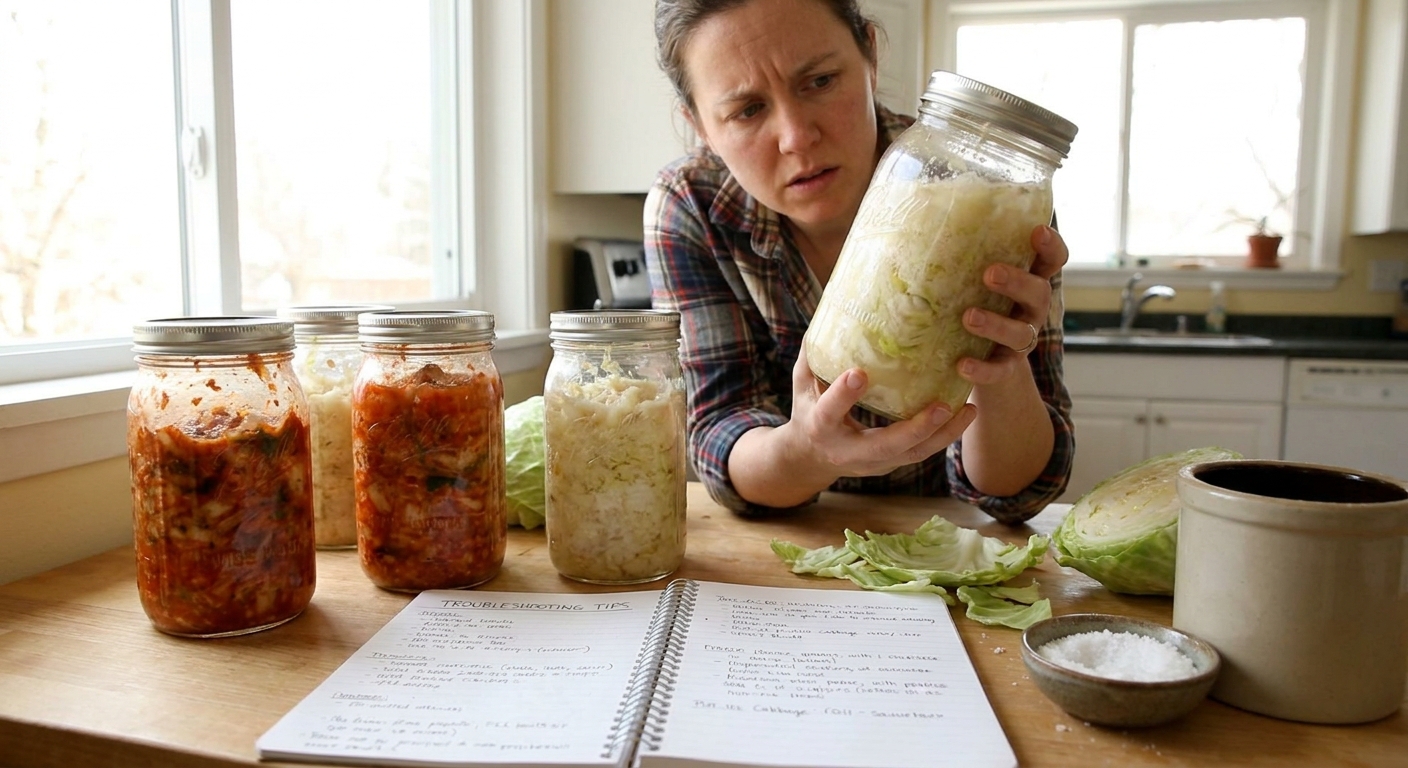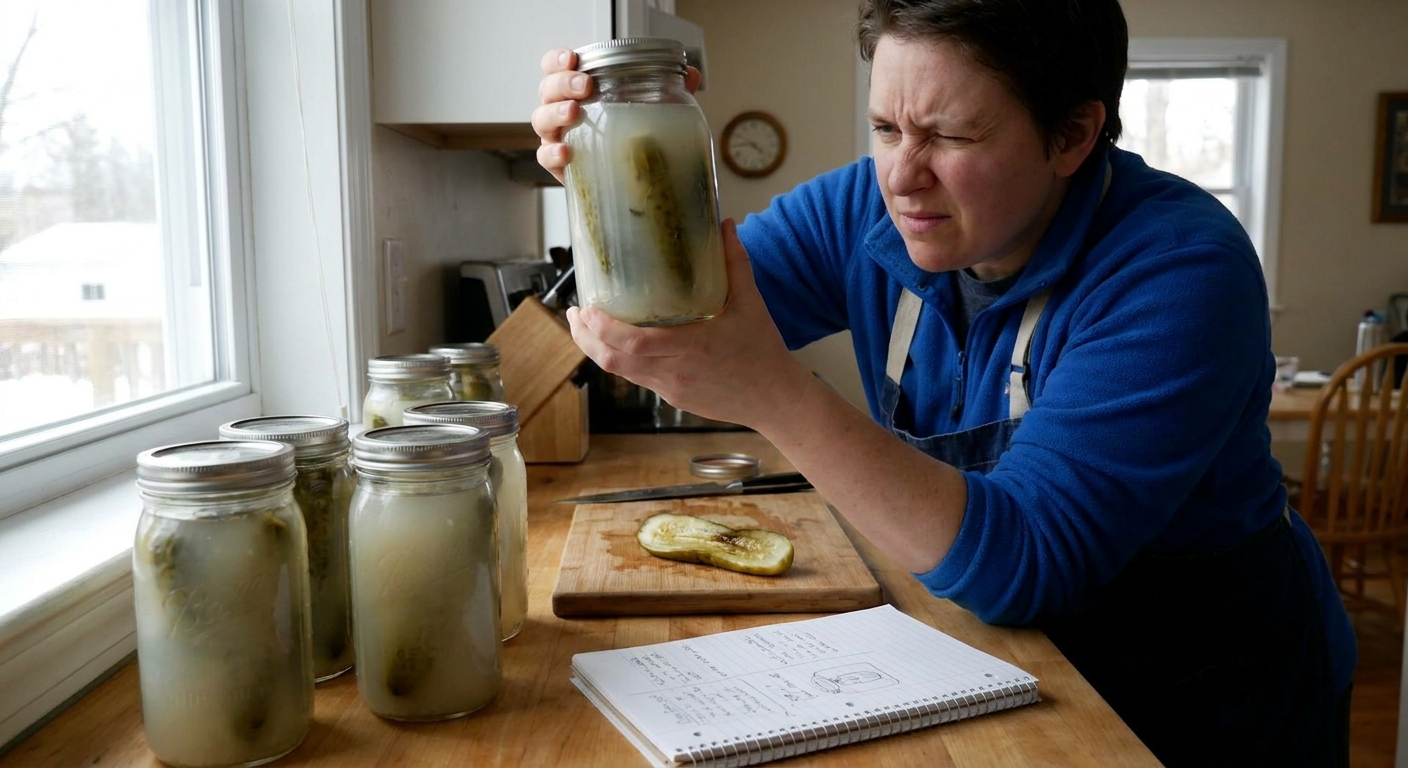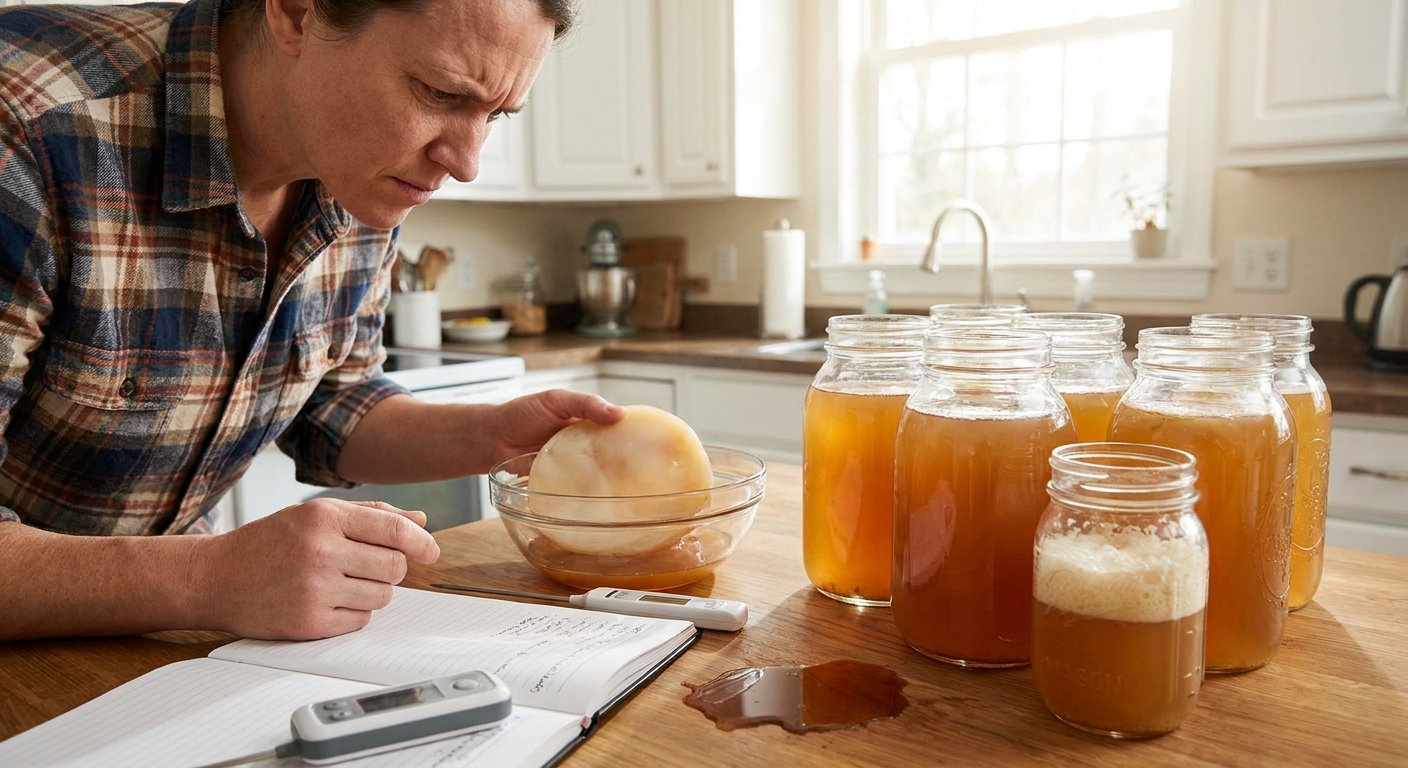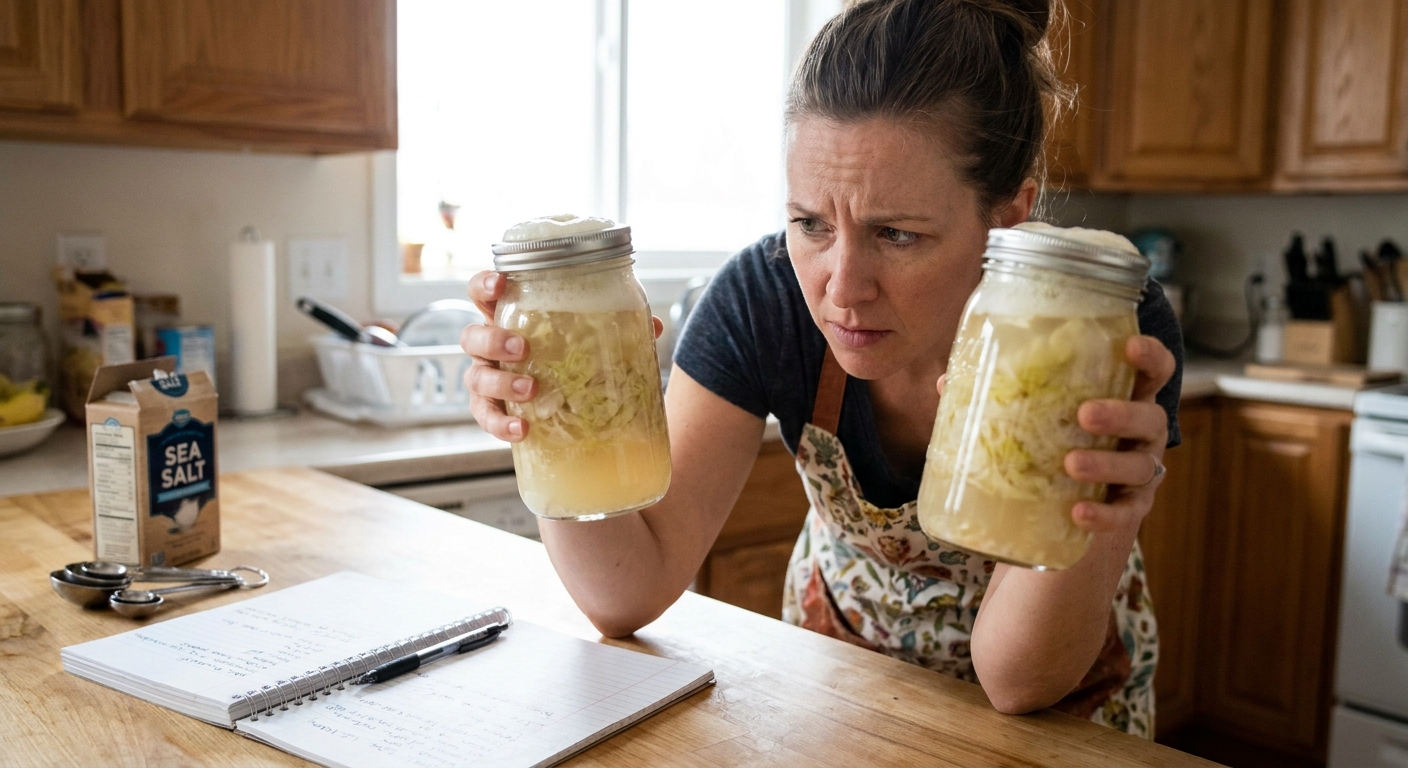
When a jar goes funky in the wrong way, it can feel mysterious and discouraging. But fermentation problems are usually predictable, fixable, and learnable. In this guide, we’ll walk through a step‑by‑step troubleshooting flow you can use for almost any vegetable or brine ferment (sauerkraut, kimchi, pickles, etc.).
Introduction
Think of this as your kitchen lab manual: we’ll check the basics (salt, time, temperature, oxygen), look at signs of success vs. trouble, and connect those signs to what’s happening microbiologically inside the jar.
Step 1: Identify the Type of Ferment
Before troubleshooting, clarify what you’re making. Each style has slightly different expectations:
- Dry‑salted ferments (sauerkraut, kimchi, shredded carrots)
- Rely on vegetable juices to create the brine.
- Need pounding or massaging to draw out liquid.
- Brined ferments (whole cucumbers, radishes, beans)
- Rely on a measured saltwater brine.
- Vegetable pieces must stay submerged.
Knowing which you have helps you check the right variables.
Step 2: Check Safety First
If any of the following are present, do not taste. Discard and start over.
- Fuzzy mold (white, green, blue, black, pink) with visible hair‑like growth.
- Colored streaks (pink, orange, red) not from known ingredients.
- Strong rotten, putrid, or fecal odor (not just sulfurous or sour).
- Slimy, ropey texture with off‑smells.
These are signs that undesirable microbes won the competition.
What’s Happening Microbiologically
In a healthy lactic acid fermentation, lactic acid bacteria (LAB) like Leuconostoc, Lactobacillus, and Pediococcus dominate. They:
- Convert sugars to lactic acid and some acetic acid.
- Lower the pH below ~4.0, which suppresses pathogens.
When brine is too weak, oxygen is present, or temperatures are off, spoilage organisms (molds, yeasts, enteric bacteria) can gain a foothold.
Step 3: Diagnose by Symptom
Use this quick index, then read the matching section.
- No bubbles / no sour smell after several days → [Section: "Nothing Seems to Be Happening"](#nothing-seems-to-be-happening)
- Jar exploded or overflowed → [Section: "Too Much Pressure"](#too-much-pressure)
- Soft, mushy vegetables → [Section: "Mushy or Slimy Texture"](#mushy-or-slimy-texture)
- White film on top → [Section: "White Film: Mold or Kahm Yeast?"](#white-film-mold-or-kahm-yeast)
- Very salty or not salty enough → [Section: "Salt Problems"](#salt-problems)
- Too sour or not sour enough → [Section: "Acidity & Flavor Balance"](#acidity--flavor-balance)
Nothing Seems to Be Happening
Symptoms
- Vegetables sit in brine with no bubbles after 3–4 days.
- Little or no sour aroma.
- Brine is not noticeably cloudy.
Possible Causes
Too cold
Too much salt
Very fresh start with slow LAB growth
Airlock too tight to see bubbles escaping through lid instead of brine
Target Conditions
- Temperature: 18–22°C (64–72°F) is ideal for most veggie ferments.
- Salt: Typically 2–2.5% by weight of vegetables (dry salt) or 2–3% in brine.
Fixes
Check the calendar
- Day 1–2: Very little visible activity is normal. - Day 3–5: Should see bubbles, cloudy brine, slight tangy smell.
Warm it up
- Move ferment to a slightly warmer spot (not above 24°C / 75°F if possible). - Place jar in a room‑temperature water bath to gently buffer against cold.
Evaluate salt level
- Taste a bit of brine with a clean spoon. - If it feels as salty or saltier than tears, salt may be high. - You can dilute by adding a small volume of unsalted water to raise total water relative to salt.
Give it time
- Some ferments, especially in cool kitchens, may need 7–10 days before strong activity shows.
Microbiology Note
In the first days, heterofermentative LAB (like Leuconostoc mesenteroides) establish themselves slowly. Once established, they produce CO₂ (bubbles), lactic acid (sour), and other flavor compounds. If conditions are marginal, this phase is just delayed.
Too Much Pressure
Symptoms
- Brine spewing out of lid.
- Bulging lids.
- Fine spray when opening.
- Very active LAB and yeasts producing CO₂.
- Airtight jars with no way to vent.
- Ferments kept too warm.
Causes
Fixes
Burping schedule for non‑airlock jars
- Days 2–5: Briefly open jar 1–2 times per day to release gas. - After day 5: Once every day or two usually suffices.
Use a tray or bowl
- Place jars on a tray to catch any overflow.
Temperature control
- Move jars to a slightly cooler area (18–20°C / 64–68°F) to slow gas production.
Microbiology Note
Active LAB and some wild yeasts ferment sugars to CO₂ and acids. In a sealed vessel, gas can’t escape, so pressure builds. This doesn’t usually harm the ferment, but it can be messy and, in extreme cases, dangerous with glass.
Mushy or Slimy Texture
Symptoms
- Cucumbers collapse or turn soft.
- Sauerkraut feels limp and soggy.
- Brine feels viscous or snotty.
Main Causes
- Too warm fermentation (above ~24–25°C / 75–77°F).
- Too little salt.
- Using overripe or damaged vegetables.
- Pectinolytic spoilage bacteria degrading plant cell walls.
Fixes
Prevent, don’t rescue
- Once a ferment is truly mushy/slimy, flavor and safety are suspect. Discard.
Adjust your next batch
- Use firm, very fresh vegetables. - Keep temps between 18–22°C (64–72°F). - Use correct salt: 2–3% brine for cucumbers is standard.
Optional helper: tannins (for pickles)
- Add a few grape, oak, or cherry leaves, or a black tea bag. - Tannins help stabilize pectins in cell walls, slowing softening.
Microbiology Note
Some spoilage bacteria and fungi secrete pectinases, enzymes that break down the pectin in plant cell walls. LAB also soften vegetables over time, but much more slowly. High temperatures and low salt favor the pectin‑destroyers.
White Film: Mold or Kahm Yeast?
Symptoms
- Thin, flat white film on the surface of the brine.
- Sometimes wrinkled, but not fuzzy.
- Mild yeasty or funky smell, not putrid.
Likely Culprit: Kahm Yeast
Kahm yeast is a collection of wild yeasts that love:
- Slightly oxygen‑rich surfaces.
- Sugars and alcohols.
- Low enough acid that they’re not fully suppressed.
They can appear even in safe, tasty ferments.
How to Tell It’s Not Mold
- Texture: Kahm is thin and matte; mold is fuzzy or raised.
- Color: Kahm is white to off‑white; mold can be green, blue, black, pink.
Fixes
Skim daily
- Use a clean spoon to remove as much as possible.
Improve submersion
- Make sure all veggies stay below brine. - Add a weight or a small, clean jar inside the fermenting jar.
Reduce headspace
- Transfer to a smaller jar once active bubbling slows, to reduce oxygen above the brine.
Safety
A bit of kahm yeast is usually harmless but can taste off. If flavor is still good and there’s no fuzz or bright colors, you can continue the ferment or move it to the fridge.
Microbiology Note
Kahm yeasts often appear later in fermentation when sugars are low but small amounts of ethanol and organic acids remain. They can oxidize acids and alcohol, flattening flavor if left unchecked.
Salt Problems
Too Salty
Symptoms
- Overwhelming saltiness.
- Slow fermentation, weak sourness.
- Mis‑measured salt (volume instead of weight).
- Very fine salt used when recipe called for coarse.
Causes
Fixes (for a current batch)
Dilution
- Remove a small portion of brine. - Replace with unseasoned, dechlorinated water. - Wait 1–2 days and taste again.
Blend later
- For kraut or kimchi, you can mix finished salty batch with unsalted fresh vegetables right before serving.
Too Little Salt
Symptoms
- Ferment races very quickly, then tastes off.
- Early mushiness or odd odors.
Fixes
- Within first 24 hours: you can stir in extra brine made at a higher salt concentration.
- After several days: if signs of spoilage appear (slime, bad smells), discard.
Microbiology Note
Salt draws water from vegetables and selectively slows many microbes more than LAB. At 2–3%, LAB are comfortable, but many spoilage organisms struggle. Above ~5–6%, even LAB slow down considerably.
Acidity & Flavor Balance
Too Sour, Too Fast
Causes
- Warmer temps (24–27°C / 75–80°F).
- Very sugar‑rich vegetables.
Fixes
- Move to fridge as soon as you like the flavor.
- Next time, ferment cooler or shorten time at room temperature.
Not Sour Enough
Causes
- Low temps.
- Too much salt.
- Not enough time.
Fixes
- Give an additional 3–5 days at room temperature.
- Check salt and adjust as described earlier.
Microbiology Note
Early in fermentation, Leuconostoc species create milder acidity and complex flavors. Later, more acid‑tolerant Lactobacillus species dominate, driving pH lower and sourness higher. Temperature and salt decide how quickly this succession happens.
A Simple Timing Guide for Veggie Ferments
Assuming 18–22°C (64–72°F):
- Day 0–1: Set‑up, salting, packing. Very quiet.
- Day 2–4: Active bubbling, increasing cloudiness, first tangy smells.
- Day 5–7: Peak flavor for many quick ferments (slaws, light pickles).
- Day 10–21: Deeper sourness and complexity (kraut, kimchi).
Taste regularly with a clean utensil, and move jars to the fridge when the flavor suits you.
Building Your Own Troubleshooting Habit
When something goes wrong, write down:
- Vegetable used and its condition (fresh, limp, damaged).
- Salt percentage and type.
- Temperature range.
- Vessel type and lid style.
- Day‑by‑day observations (bubbles, smells, visual changes).
Over just a few batches, you’ll start to see patterns. That’s how you move from following recipes to understanding the fermentation ecosystem in your own kitchen.
Remember: every failed jar is a lesson in microbiology and craft. The microbes are consistent; we just have to learn what they’re telling us.