Wild ferments—kombucha, ginger bug, water kefir, fruit sodas—feel magical when they work: lively bubbles, tangy aromas, bright flavors. When they stall, mold over, or explode, they can feel confusing or even dangerous.
Introduction
This guide focuses on troubleshooting wild and mixed‑culture ferments, with an emphasis on kombucha SCOBYs and ginger bugs. We’ll tackle common failures, step‑by‑step rescue attempts, and the microbiology that makes these ferments more fragile than salted vegetables.
Part 1: Kombucha Troubleshooting
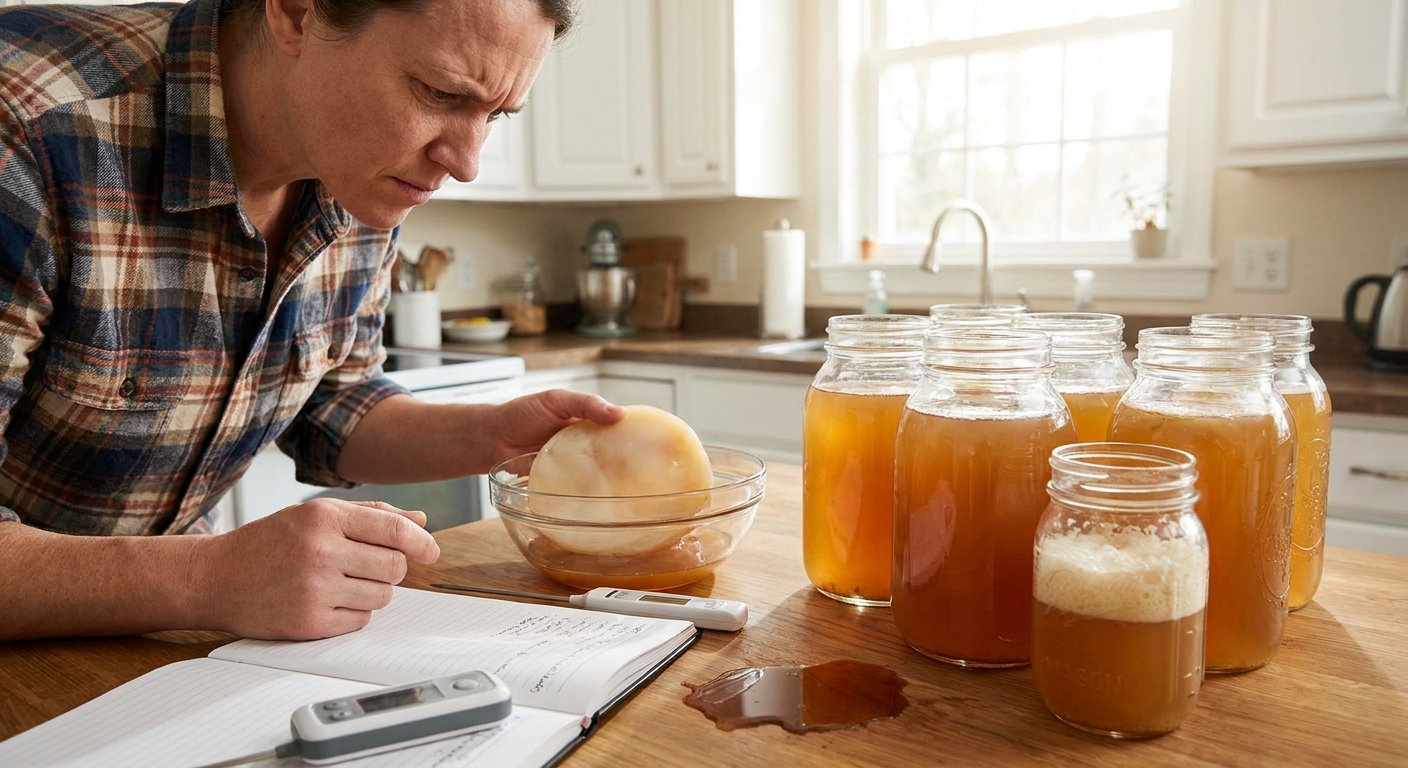
Kombucha is a sweet tea fermented by a SCOBY (symbiotic culture of bacteria and yeast). That pellicle disk on top isn’t just a decoration; it organizes the whole ecosystem.
Ideal Starting Conditions
- Tea: Real black or green tea (Camellia sinensis), not herbal blends.
- Sugar: Regular white sugar (sucrose) is simplest.
- Starter liquid: 10–20% finished, unflavored, unpasteurized kombucha.
- Temperature: 22–27°C (72–80°F) for active fermentation.
- Oxygen: Open system, covered with breathable cloth.
If you’re far from these conditions, expect trouble.
Symptom 1: No New SCOBY, No Tang After 7–10 Days
Likely Causes
- Weak or dead starter (pasteurized store‑bought kombucha, or too little starter).
- Too cold environment.
- Too high sugar to tea ratio (osmotic stress on microbes).
Diagnostic Steps
- Check temperature around the jar.
- Smell the brew.
- Sweet tea aroma with no tang? Fermentation may not have started.
- Any off or rotten smell? Discard.
Rescue Steps
Warm it up
- Move to a warmer spot, ideally 24–26°C (75–79°F).
Extend time
- Wait an additional 4–5 days. - Look for: - Thin translucent layer forming on top. - Shift from sweet to mildly tangy.
If still nothing after ~14 days and no acid smell:
- Discard and restart with a verified live starter.
Microbiology Note
Kombucha cultures are dominated by acetic acid bacteria (e.g., Komagataeibacter species) and yeasts like Zygosaccharomyces. The bacteria create the cellulose pellicle (SCOBY) and acetic acid; yeasts supply ethanol and CO₂. If starter lacks enough living bacteria/yeast, nothing builds.
Symptom 2: Mold on SCOBY
What Mold Looks Like
- Dry, fuzzy growth on the surface.
- Colors: blue, green, black, sometimes white but clearly fuzzy.
- Appears as spots or islands, not an even, smooth film.
Action
- Do not attempt to salvage the SCOBY or starter liquid.
- Discard all contents.
- Wash vessel thoroughly with hot, soapy water and rinse well.
Prevention
- Use strong, acidic starter: the starting pH should be below ~4.5.
- Keep brew covered with cloth, not sealed plastic or metal lids.
- Avoid cool, stagnant spots; aim for room‑warm locations.
Microbiology Note
In early kombucha fermentation, before acidity drops, airborne mold spores can colonize the sugar‑rich surface. Once pH is low and acetic acid is present, mold has a much harder time, but by then it may already have taken hold if conditions were slow and cool.
Symptom 3: Vinegary, Harsh Kombucha
Likely Causes
- Fermentation ran too long.
- Warm temperatures accelerated acetic acid production.
Hands‑On Fixes
- Reserve over‑soured kombucha as starter for future batches.
Dilute for drinking:
- Mix with fresh tea, juice, or water. - Use in salad dressings or marinades.
Prevention
- Taste at day 5–7 and then daily.
- When sweetness–acidity balance is right for you, bottle and refrigerate or move to second fermentation.
Microbiology Note
Acetic acid bacteria keep oxidizing ethanol to acetic acid as long as sugar and oxygen are available. Warmer temperatures speed this up. Eventually, the drink becomes closer to vinegar than kombucha.
Symptom 4: No Bubbles in Bottled Kombucha (Flat Second Ferment)
Likely Causes
- Yeast population too low.
- No priming sugar added at bottling.
- Bottles stored too cold.
Fixes
Check priming sugar
- Add a small amount of sugar, juice, or fruit (about 2–3% by volume) to bottled kombucha.
Ensure warmth
- Store bottles at room temperature (20–24°C / 68–75°F) for 2–4 days.
Gently swirl once a day
- Redistribute yeasts; don’t shake hard.
If still flat after 5–7 days
- Use more yeast‑rich kombucha from the bottom of the fermentation vessel next time.
Microbiology Note
Carbonation comes from yeasts converting sugars to CO₂ in sealed bottles. If the main ferment runs until almost all sugar is gone or the culture is heavily bacteria‑dominant, there may not be enough yeast or fermentable sugar left to create fizz.
Part 2: Ginger Bug Troubleshooting
A ginger bug is a wild‑caught culture of yeast and bacteria grown in a mixture of ginger, sugar, and water. It’s a powerful starter for homemade sodas—but also prone to stalls and molds.
Ideal Conditions
- Fresh ginger (unpeeled, organic if possible).
- Non‑chlorinated water.
- Daily feeding with sugar and ginger.
- Warmish room (20–26°C / 68–79°F).
Symptom 1: No Bubbles After 5–7 Days
Likely Causes
- Water too cold.
- Chlorinated water.
- Not enough sugar.
- Very low ambient yeasts (rare but possible in ultra‑sterile environments).
Rescue Steps
Check temperature
- Move jar to a warmer area.
Address chlorine
- Switch to filtered, boiled‑then‑cooled, or left‑out‑overnight tap water.
Feed generously
- Add 1–2 tsp sugar and 1–2 tsp freshly grated ginger daily. - Stir vigorously to introduce oxygen.
Give it more time
- Some kitchens take 7–10 days to build a vigorous bug.
If after 10 days there are still zero bubbles and no slightly yeasty or ginger‑beer aroma, start over with new ginger.
Microbiology Note
Ginger surfaces and your kitchen air contribute wild yeasts (often relatives of Saccharomyces and Candida) and lactic acid bacteria. They need sugar for energy and a mild environment to grow. Chlorine and cold both hold them back.
Symptom 2: Mold on Ginger Bug
Just like kombucha, mold is non‑negotiable.
Appearance
- Fuzzy patches, often on floating ginger pieces.
- Green, black, blue, or occasionally pink.
Fix
- Discard contents.
- Wash jar thoroughly.
- Start fresh; this time, keep solids fully submerged in liquid and stir more often.
Prevention
- Use a clean spoon every time.
- Ensure ginger pieces don’t sit high and dry on the sides of the jar.
Symptom 3: Ginger Bug Smells Strongly Rotten or Rancid
Likely Causes
- Infrequent feedings.
- Very warm environment without acidity to protect.
Action
- If the smell is clearly putrid, not just strong or alcoholic, discard.
- Start a new bug, being consistent with daily feeds.
Microbiology Note
A healthy ginger bug transitions from sweet to lightly acidic and yeasty. If LAB never establish adequate acidity, protein‑degrading or spoilage microbes can dominate, leading to foul odors.
Using a Ginger Bug Safely in Soda
When your ginger bug is bubbly 12–24 hours after feeding and smells pleasantly yeasty:
- Strain 2–4 tbsp of liquid into sweetened juice, herbal tea, or flavored sugar water.
- Bottle in sturdy bottles with headspace.
- Ferment at room temperature 1–3 days, burping daily.
- Refrigerate once carbonated.
If bottles don’t carbonate, next time use more active bug or increase sugar slightly.
Part 3: General Wild Ferment Safety Checks
Whenever a wild ferment (kombucha, ginger bug, water kefir, fruit soda) seems off, walk through this triage:
Look
- Any fuzzy, brightly colored growth? → discard. - Even film, consistent pellicle, or yeast strands? → often normal.
Smell
- Pleasant sour, fruity, alcoholic, or yeasty? → usually okay. - Rot, vomit, sewage, ammonia, strong rancidity? → discard.
Time & Temperature
- Did you leave it very long at a high temperature? - Was starter culture or bug obviously active when you used it?
Taste carefully (if previous checks pass)
- Use a clean spoon. - If taste is harsh, chemical, or deeply unpleasant, spit out and discard.
Wild ferments are more oxygen‑rich and salt‑poor than vegetable ferments, so you must be more conservative about questionable batches.
Final Thoughts: Partnering with Your Cultures
Kombucha SCOBYs and ginger bugs are living communities. They tell you about their health through:
- How fast they acidify.
- How they smell.
- Whether bubbles appear.
- How they respond to feeding and warmth.
When something goes wrong, don’t just toss and forget. Ask:
- Was my starter definitely alive and active?
- Did I give enough sugar and the right temperature?
- Did I accidentally invite mold with a slow, weak start?
Record your observations. Over time, you’ll learn the personality of your cultures and kitchen. Troubleshooting will feel less like crisis management and more like adjusting care for a houseplant—observant, patient, and grounded in how these tiny organisms really live.