Crisp brined pickles are one of the pure joys of home fermentation. But if you’ve ever opened a jar to find soft, hollow, or slimy cucumbers, you know how heartbreaking it can be.
Introduction
This article is your hands‑on troubleshooting lab for brined vegetables: cucumbers, green beans, radishes, carrots, peppers, and more. We’ll focus on how to keep things crunchy, safe, and delicious—and why the microbes care so much about your salt, temperature, and produce choice.
First Principles of Brined Vegetable Fermentation
Before troubleshooting, let’s set the baseline.
Basic Brine Formula
Most brined vegetables do well at 2–3% salt by weight of water:
- 2% brine: 20 g non‑iodized salt per 1 L water.
- 3% brine: 30 g non‑iodized salt per 1 L water.
Cucumber pickles often prefer 2.5–3% to stay safe and crisp.
Essential Conditions
- Fresh, firm veggies (especially for cucumbers).
- Chlorine‑free water (chlorine can inhibit LAB).
- Cool fermentation temps: 18–22°C (64–72°F).
- Full submersion under brine.
When any of these pillars wobble, that’s where trouble starts.
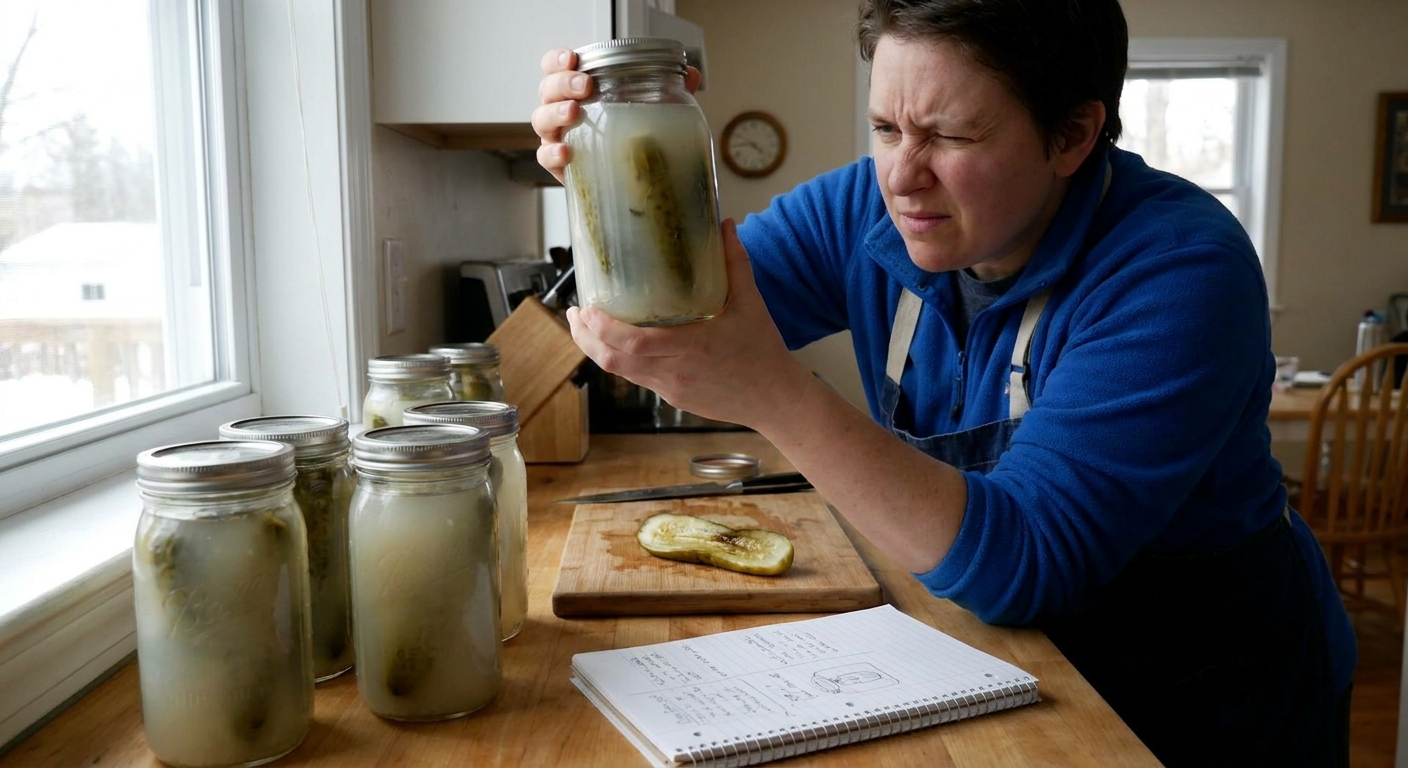
Symptom 1: Mushy or Hollow Pickles
What You’re Seeing
- Cucumbers that bend instead of snap.
- Interiors that look hollow or cottony.
- Beans or carrots that feel rubbery.
Likely Causes
Old or overripe vegetables
Too warm fermentation
Inadequate salt
Long room‑temperature fermentation
Pectinolytic spoilage microbes (pectin‑eating bacteria and fungi)
Step‑By‑Step Fix (for Current Batch)
If the texture is starting to soften but flavor is still good and there are no off‑odors:
- Move to the fridge immediately.
- Cold slows pectin breakdown.
- Eat sooner rather than later.
- Plan to consume within 1–2 weeks.
If pickles are already mushy or slimy:
- Discard the batch. Sadly, there is no reliable way to restore structure once pectin is degraded and slime appears.
Prevention for Next Time
Use very fresh produce
- Pick or buy cucumbers just before fermenting. - Avoid waxed cucumbers (the wax traps spoilage organisms and slows brine penetration).
Control temperature
- Aim for 18–20°C (64–68°F) for crisp pickles. - In hot weather, consider a cool basement or a water bath to buffer heat.
Use enough salt
- For cucumbers: 2.5–3% brine is a reliable starting point.
Limit time at room temperature
- Often 5–7 days at room temp is enough. - Then refrigerate to finish slowly.
Consider tannins
- Add a few grape leaves, oak leaves, sour cherry leaves, or a black tea bag. - Tannins help reinforce pectin in cell walls, resisting softening.
Microbiology Focus
Plant cell walls are held together by pectin, a complex carbohydrate. Some spoilage microbes secrete pectinases, enzymes that break pectin apart. High salt and cool temperatures slow these pectin‑eaters and favor LAB that acidify the environment before damage is done.
Symptom 2: No Bubbles, No Sourness After a Week
Likely Causes
- Too cold environment.
- Excess salt in the brine.
- Chlorinated water.
Hands‑On Diagnostic
Check room temperature
- If it’s below ~18°C (64°F), fermentation will be sluggish.
Taste the brine (with a clean spoon)
- If it tastes harsher than tears, brine may be strong.
Think about your water source
- Tap water with strong chlorine or chloramine can suppress LAB.
Fixes
Warm it up
- Move jar to a warmer space (but not hot sun).
Adjust salt if needed
- Remove some brine and replace it with dechlorinated water (boiled and cooled, or filtered) to slightly reduce salinity.
Consider re‑starting if after another 3–4 days:
- There are still zero bubbles, no sourness, and no cloudiness. - For high‑risk items like whole cucumbers, it’s often safer to start fresh than to gamble.
Microbiology Focus
LAB are present on vegetable surfaces but need favorable conditions to begin dividing:
- Enough water to move nutrients.
- Salt levels that inhibit competitors but not themselves.
- Temperatures that support enzyme activity.
If they’re too slowed, early‑stage opportunists or spoilage microbes may move in instead.
Symptom 3: Cloudy Brine and White Film on Top
Cloudy brine alone is often a good sign of active fermentation. The question is: what’s the white film?
Flat White Film → Kahm Yeast
- Thin, matte, sometimes wrinkly layer.
- Not fuzzy or raised.
- Mild yeast or flat beer smell.
Action:
- Skim off with a clean spoon.
- Check that all vegetables are fully submerged.
- Taste a sample. If flavor is pleasantly sour and vegetal, you’re okay.
Fuzzy Growth → Mold
- Soft or hairy texture.
- Colors: white, green, blue, black, sometimes pink.
Action:
- For beginners, the safest practice is to discard the batch.
- Mold indicates oxygen exposure and imbalance in microbe populations.
Microbiology Focus
Kahm yeast thrives at the air–brine interface where oxygen is available but acidity is rising. LAB are fine under the brine, but yeasts, molds, and other aerobes can exploit any exposed surfaces.
Symptom 4: Pickles Too Salty or Not Salty Enough
Too Salty
Fixes for Current Batch
Dilute gradually
- Remove some brine (up to 25%). - Replace with dechlorinated water. - Taste again after 1–2 days.
Serve with balancing foods
- Chop salty pickles into salads with unsalted vegetables or grains.
Not Salty Enough
Warning Signs
- Pickles taste like barely salted vegetables.
- Fermentation seems wild and rapid.
- Early softening or odd skunky smells.
Fixes
- Within first 24 hours: pour off some weak brine and replace with more concentrated brine (for example, 4–5%) to raise the overall salt.
- Beyond a couple of days: if softness or off‑smells appear, discard.
Microbiology Focus
Salt acts as a selective stress. LAB tolerate mild salt stress better than many competitors. If salt is too low, a broader array of microbes—including unwanted ones—can grow. If too high, even LAB go dormant.
Symptom 5: Strong, Sharp, or Off Flavors
Overly Sharp Acidity
- Ferment may have gone too long at warm temperatures.
- Move to the fridge immediately.
- Next time, shorten room‑temp time or ferment cooler.
Fix:
Bitter Notes
- Over‑extracted spices (too much clove, allspice, bay, etc.).
- Excess tannins from leaves or tea bags.
- Rinse pickles briefly before serving.
- Reduce spice/tannin levels next batch.
Fix:
Rotten or Putrid Smells
- Strong indication of spoilage.
- Discard without tasting.
Fix:
Microbiology Focus
Different microbes generate different metabolic byproducts:
- Healthy LAB: lactic acid, mild acetic acid, diacetyl (buttery), and other pleasant notes.
- Spoilage bacteria: sulfurous, amine, or putrid compounds.
Your nose is an excellent tool for distinguishing them; trust it.
Practical Timing Guide for Brined Veggies
Assuming ~20°C (68°F):
- Day 0: Pack vegetables, cover with brine, weight, and close.
- Days 1–3: Mild bubbling, brine starts to cloud, flavors lightly salty.
- Days 4–7: Peak LAB activity; sourness and complexity develop.
- Days 7–14: Best window for crisp yet flavorful pickles.
Taste daily starting day 4 with a clean utensil. When texture and acidity are right for you, refrigerate.
A Simple Daily Check Routine
To catch problems early and avoid full‑blown failures, use this 1‑minute routine:
Look
- Are vegetables still under brine? - Any new film, fuzz, or color changes?
Smell
- Sour, fresh, spicy, garlicky? Good. - Rotten, chemical, or fecal? Discard.
Release gas (for sealed jars)
- Loosen lid slightly to vent CO₂ in first 3–5 days.
Adjust
- Skim any surface growth. - Add more brine if needed.
This kind of gentle, regular attention turns you into a much more reliable fermenter.
Closing Thoughts: Learning to Think Like a Microbe
When you see mushy pickles or smell something off, pause and ask:
- Was I giving LAB a head start (enough salt, cool temperature, full submersion)?
- Did I accidentally favor pectin‑eaters and spoilage microbes (warm, low salt, old veggies)?
Each jar is a small experiment in applied microbiology. Keep some notes, compare batches across seasons, and soon you’ll be able to predict and prevent most problems.
The difference between heartbreak and crunchy, tangy success is rarely magic—it’s usually a few degrees of temperature, a gram or two of salt, or a day more (or less) at room temperature. Keep adjusting, keep observing, and your microbes will meet you halfway.