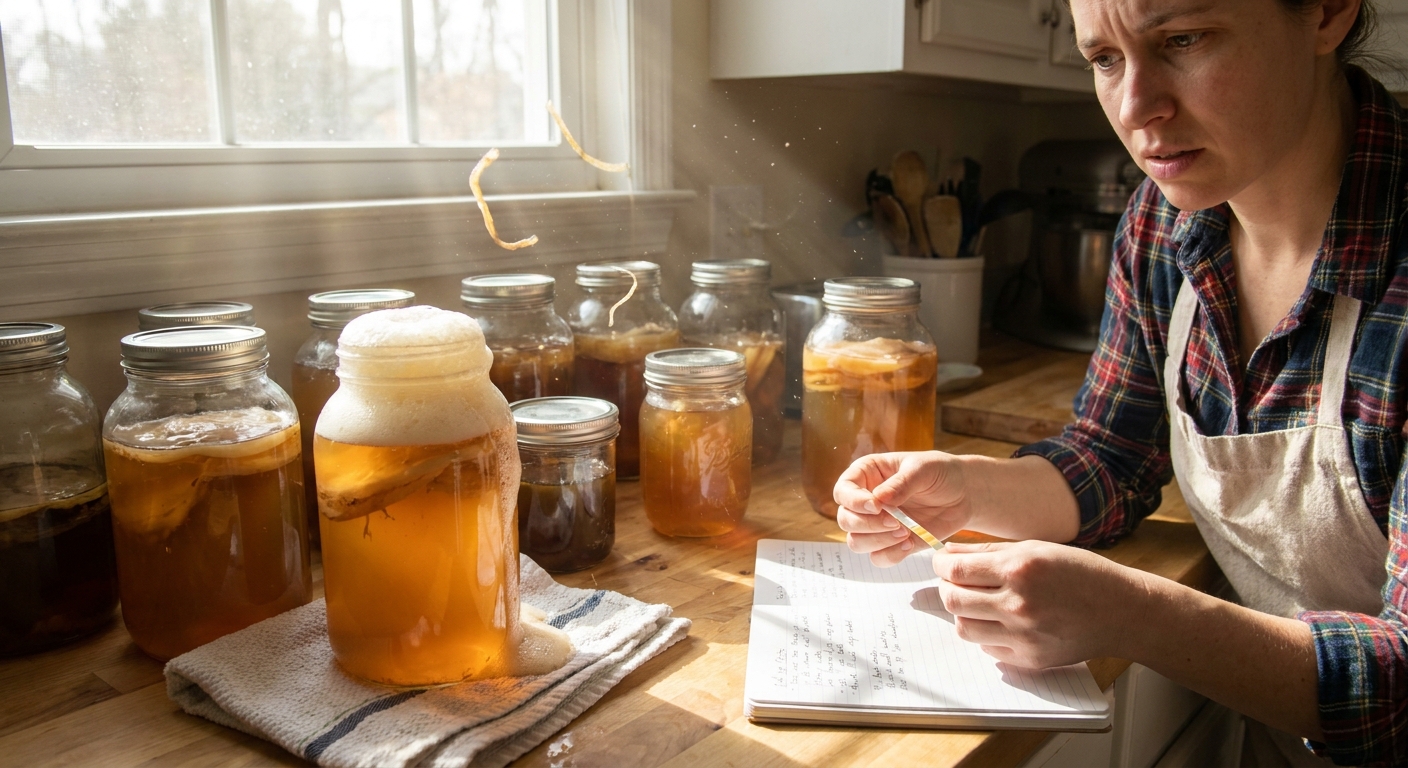
Every seasoned kombucha brewer has had a flat bottle, a vinegar bomb, or a mysterious science project in the corner. The goal isn’t perfection on batch one—it’s learning to read what your microbes are telling you and adjusting calmly.
Why Troubleshooting Matters
This playbook walks you through common problems, what’s happening microbiologically, and the exact steps to fix—and often prevent—them.
Quick Diagnostic Checklist
Before diving deep, answer these for any problematic batch:
Temperature range?
- Below 20°C / 68°F? Expect slow, weak fermentation. - Above 28°C / 82°F? Microbes may be stressed, harsh acids build quickly.
How many days in first ferment (F1)?
- Under 5? Likely too sweet, low acid. - Over 14? Likely very sour, low residual sugar.
Starter tea used?
- Volume? (Aim: 10–20% of total volume.) - Was it raw and unflavored?
Type of sugar and tea?
- White sugar + black/green tea = most reliable.
Appearance and smell?
- Mold, vinegar, yeast bombs?
Keep these answers handy as you read the relevant section.
Problem 1: “My Kombucha Has Mold”
How to Recognize Mold
Mold is:
- Fuzzy or hairy
- Dry-looking, sitting on top of the surface
- Often circular spots
- Colors: blue, green, black, or bright white
- Smooth, jelly-like, or rubbery layers (new SCOBY)
- Brown strings or blobs hanging from SCOBY (yeast)
- Bubbles trapped in the SCOBY
Not mold:
Why Mold Happens (Microbiology)
Mold grows when:
- The pH doesn’t drop fast enough (not enough starter tea)
- Temperature is too low (bacteria sluggish, mold wins race)
- The surface is exposed to airborne spores in a favorable environment
What to Do
- Discard the entire batch, SCOBY included.
- Wash the jar with hot, soapy water and rinse well.
- Optionally rinse with vinegar, then rinse again.
- Restart with a fresh SCOBY and plenty of starter tea.
There is no safe way to “scrape off” mold.
Preventing Mold
- Use 10–20% starter tea by volume.
- Keep temperature around 22–26°C / 72–79°F.
- Avoid fermenting near houseplants, bread, or other mold-prone areas.
- Cover jar with a tightly woven cloth or paper towel.
Problem 2: “It’s Too Sweet, Even After a Week”
Likely Causes
- Room too cold (below ~20°C / 68°F)
- Weak starter tea or not enough of it
- Old or weak SCOBY
- Brewed with herbal or decaf tea only
Microbiology Behind It
Yeasts and bacteria slow way down when cold. Without enough active microbes, sugar doesn’t get converted to acids, and your tea stays sweet.
How to Fix This Batch
- Move the jar to a warmer location.
- Give it another 2–5 days and taste again.
- If still very sweet with no tang at all, your culture may be weak—use this batch as fertilizer and restart with a robust SCOBY and fresh starter.
Prevent Next Time
- Aim for 21–27°C / 70–80°F.
- Use real tea (black or green) as at least 50–75% of your blend.
- Make sure your starter tea is from a recent, strong batch—tart but not harsh.
Problem 3: “It Turned to Vinegar”
Symptoms
- Extremely sour, sharp, and astringent
- Almost no sweetness remaining
- Sometimes a light solvent or nail polish note if terribly over-fermented
What’s Happening Microbially
- Yeasts already converted sugar → alcohol
- Acetic acid bacteria turned that alcohol → acetic acid (vinegar)
- With time, these bacteria dominate and keep building acidity
How to Use Vinegary Kombucha
Don’t waste it. Use it as:
- Salad dressing base (like apple cider vinegar)
- Marinades
- Cleaning vinegar (test on small surfaces first)
- Starter tea for future batches (if not too extreme)
Prevent Next Time
- Mark your start date on the jar.
- Start tasting on day 5–7.
- In warm temps, rarely go past 7–10 days for the first ferment.
Problem 4: “My Bottles Are Flat”
Possible Causes
- Not enough residual sugar at bottling time
- Too little flavoring/sugar added for second ferment
- Too cold during second ferment
- Weak yeast population
- Leaky or low-quality caps
The Science
- Yeasts need fermentable sugar + time + warmth.
- CO₂ produced must be trapped by a tight seal to become carbonation.
Steps to Fix (If Already Bottled)
- Move bottles to a warmer spot (22–26°C / 72–78°F).
- Gently invert bottles once to rouse yeast.
- Wait 2–3 more days, then chill a tester.
If still flat:
- Open each bottle.
- Add ½–1 tsp sugar or juice per 500 ml bottle.
- Reseal, leave 2–3 more days at room temp.
Prevention
- Bottle when kombucha is lightly tart but still somewhat sweet.
- Add enough flavoring (with sugar) to feed carbonation.
- Use solid swing-top or soda bottles, and check seals.
Problem 5: “My Bottles Are Exploding or Gushing”
Why It Happens
- Too much sugar at bottling
- Extremely warm environment
- Bottling from a very active, sweet first ferment
- Using highly carbonatable bottles (like thin recycled glass) without burping
Microbial Explanation
Yeasts work overtime, converting abundant sugar into gas. If there’s nowhere for that gas to go, pressure builds until the weakest point gives—often the bottle.
Safety First
- If you suspect over-carbonation, chill bottles overnight (cold slows yeast).
- Open over a sink, with a towel over the cap.
- Wear eye protection if bottles feel rock-hard.
Prevention
- Don’t add excessive sugar: usually 2–3 tbsp fruit or 1–2 tsp sugar per 500 ml is enough.
- In warm weather, shorten second ferment to 1–2 days, then chill.
- Burp glass bottles daily when learning your system.
Problem 6: “The SCOBY Looks Weird… Is It Dead?”
Normal Weirdness
- Brown strands hanging down (yeast colonies)
- Bumps, bubbles, and ridges
- A thin cream-colored film forming on top (new SCOBY)
- Dark patches where tea tannins collect
Signs of Trouble
- Dry, cracking, or shriveled SCOBY
- Blue, green, or black spots (mold—discard)
- Strong off smells like rot or cheese
Microbiology Insight
The SCOBY is a living cellulose mat housing acetic acid bacteria. It responds to:
- Temperature
- Tea type
- Oxygen
Each batch can look different. The health of your brew is better judged by smell and taste than SCOBY beauty.
Problem 7: “White Clumps or Sediment in My Bottle”
What It Is
- Tiny baby SCOBYs forming where air meets the surface
- Yeast sediment settling at the bottom
Is It Safe?
Yes, it’s normal and safe to drink. If texture bothers you:
- Strain kombucha before drinking.
- Pour gently to leave sediment in the bottle.
Why It Happens
Residual yeasts and bacteria are still active in the bottle, building micro-colonies in the presence of a bit of oxygen.
Problem 8: “It Smells Like Nail Polish Remover”
Cause
You’re likely smelling ethyl acetate or similar solvents, a byproduct when fermentation runs extremely hot, long, or stressed.
What’s Happening
Some wild yeasts and bacteria, under nutritional or heat stress, create solvent-like compounds instead of the pleasant acids you want.
What to Do
- Do not drink if the smell is strong and unpleasant.
- Discard the batch.
- Start fresh with a healthy SCOBY and balanced tea.
Prevention
- Keep temperature in range (21–27°C / 70–80°F).
- Use proper nutrients: real tea and white sugar.
- Don’t let batches sit for many weeks unattended in hot spots.
Building a Personal Kombucha Log
To become your own best troubleshooter, keep a simple notebook or digital log:
- Date started & bottled
- Room temperature range
- Tea and sugar amounts
- Starter tea volume
- Tasting notes (days 5, 7, 9…)
- Problems and fixes
Patterns will jump out: maybe every summer batch ferments twice as fast; maybe your favorite flavor only needs 24 hours of second ferment.
When in Doubt, Trust Your Senses
As you brew more, you’ll learn what “healthy kombucha in progress” smells and looks like:
- Aroma: fruity-vinegar, tea-like, tangy
- Look: evolving SCOBY, some sediment, maybe bubbles
- Taste: moving from sweet to tangy over days
If a batch looks strange but smells clean and tastes pleasant, it’s usually fine. If smell or instinct says no, listen to that.
Troubleshooting isn’t a sign you’re failing; it’s how you become fluent in fermentation. Each odd batch is a little lesson from your microbes—this playbook just helps you translate.