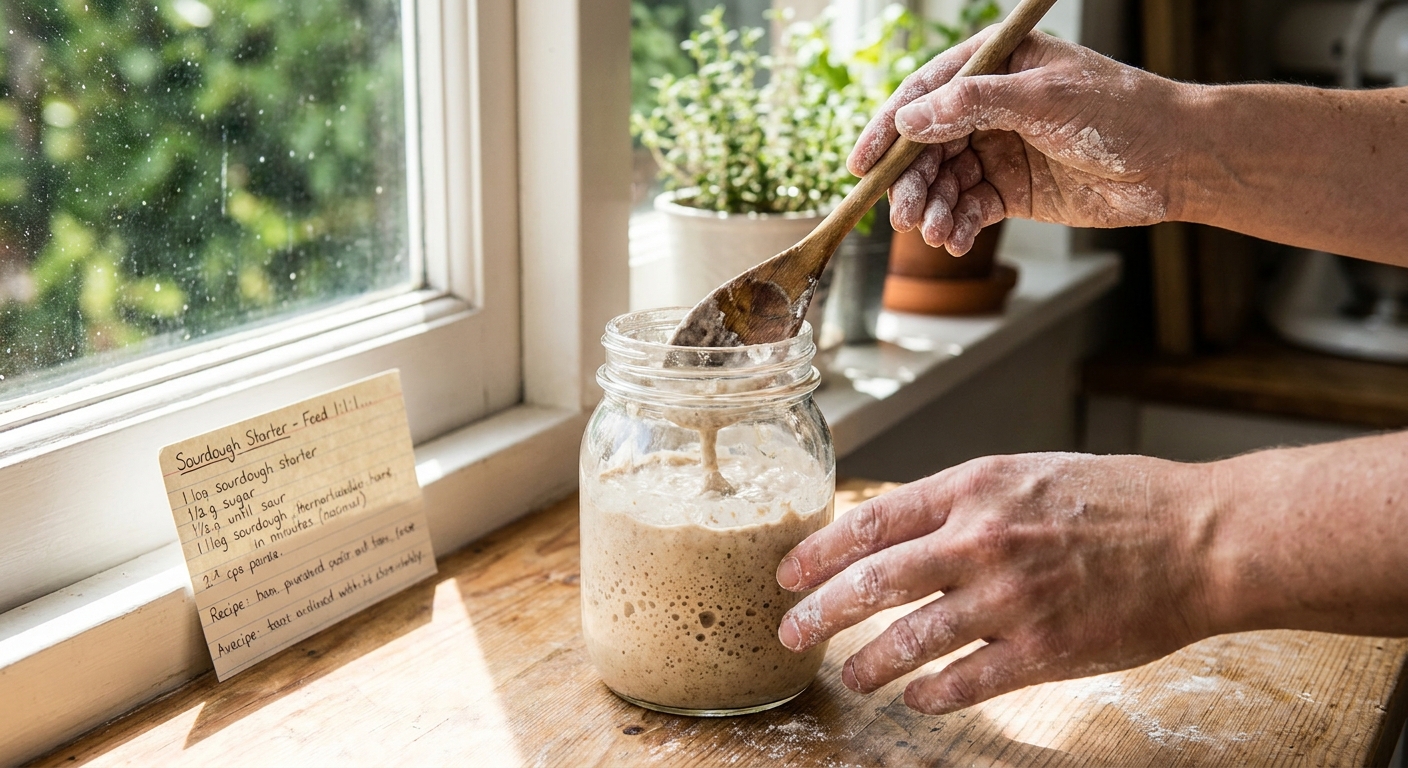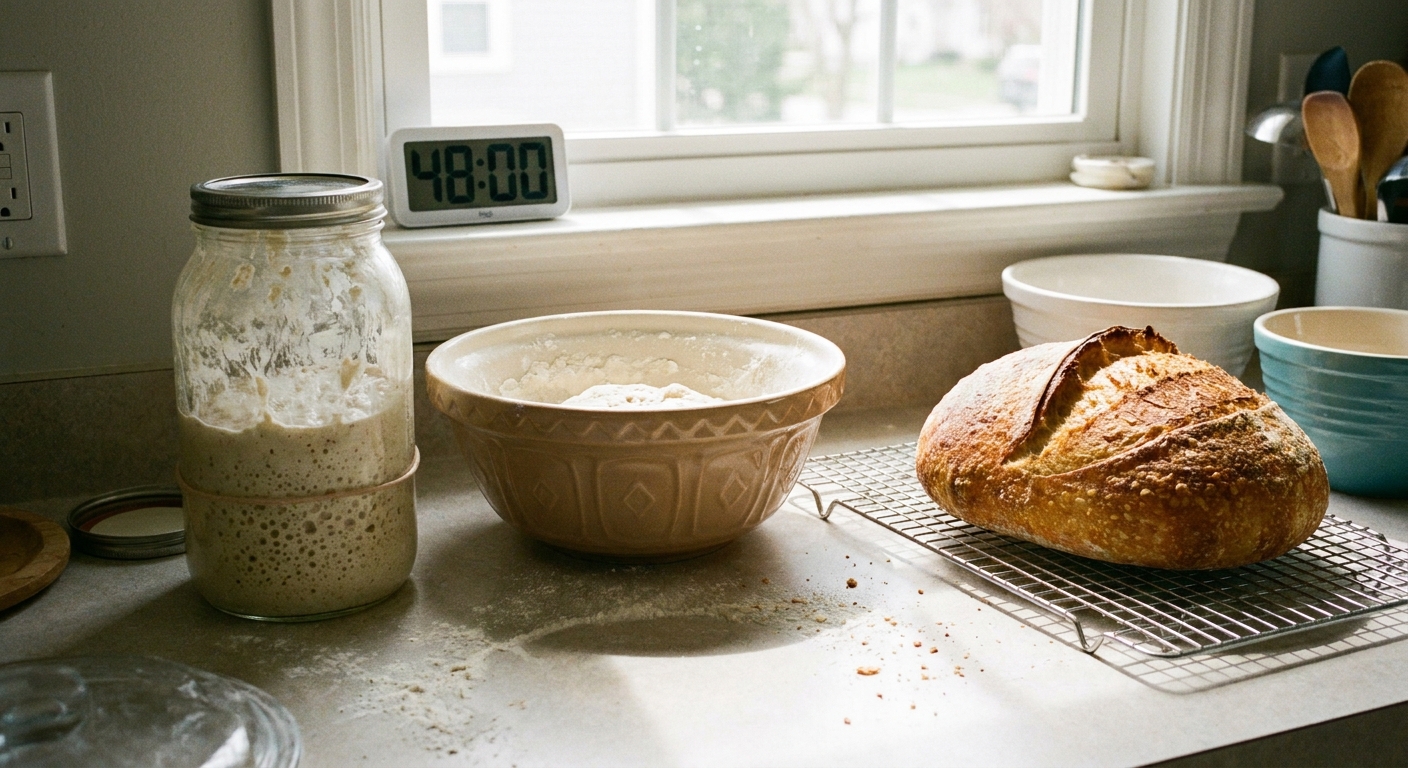
Sourdough isn’t hard, it’s just slow. Once you understand when each stage happens, you can tuck the process around your life instead of hovering over dough all day.
Overview: Why Sourdough Takes Time (and How to Plan Around It)
This guide lays out a 48‑hour timeline for one country‑style loaf, with clear checkpoints, clock times, and the microbiology that explains what’s happening inside the dough.
We’ll assume you already have an active starter that doubles in 6–8 hours.
Gear and Formula
Equipment
- Kitchen scale
- Mixing bowl or dough tub
- Bench scraper or spatula
- Proofing basket or bowl lined with a floured towel
- Dutch oven or baking stone + steam setup
- Razor or sharp knife for scoring
Basic Formula (70% Hydration Loaf)
For 1 medium loaf (~800–900 g baked weight):
- 350 g bread flour
- 150 g whole wheat flour
- 350 g water (room temp)
- 90 g active starter (100% hydration)
- 9 g salt (about 2% of total flour)
Total flour: 500 g
Total water: 350 g (70% hydration)
Day 1 Morning: Feed Your Starter
Goal: Have your starter at peak activity when you mix the dough.
8:00 AM – Feed Starter
- Discard starter down to 40 g.
- Add 40 g water + 40 g flour (1:1:1 ratio).
- Stir and leave at 24–26°C (75–79°F) if possible.
Microbiology note: Yeasts and LAB wake up, start feeding, and multiply. You’re aiming to catch them at their most active phase, when gas and acid production are balanced.
Your starter should peak (double in size) in ~4–6 hours. Adjust your feeding time so the peak lines up with your mix time.
Day 1 Midday: Autolyse and Mix
12:00 PM – Autolyse (Optional but Helpful)
Autolyse is simply mixing flour and water and letting it rest before adding salt and starter.
In a bowl, mix:
- 350 g bread flour - 150 g whole wheat flour - 325 g of the 350 g water (reserve 25 g for later) 2. Mix until no dry spots remain. 3. Cover and rest 30–60 minutes.
What’s happening?
Enzymes in flour begin breaking down starches into sugars. Gluten bonds start forming on their own, which improves dough strength without much kneading.
1:00 PM – Final Mix
- Check your starter: it should be doubled, bubbly, and domed.
Add to your autolysed dough:
- 90 g active starter - 9 g salt - Remaining 25 g water 3. Pinch and fold the dough until everything is fully incorporated.
The dough will feel shaggy but should hold together.
Microbiology note: You’ve just inoculated the big flour/water mixture with your microbial culture. Yeasts will produce CO₂ for rise; LAB will generate acids that strengthen gluten and add flavor.
Day 1 Afternoon: Bulk Fermentation
Bulk fermentation is the first rise, when dough ferments as one mass.
1:15–5:15 PM – Bulk Fermentation (About 4 Hours)
Ideal temperature: 24–26°C (75–79°F).
Coil Folds or Stretch‑and‑Folds
Perform 3–4 rounds of folds in the first 2 hours:
- 1:45 PM: First fold
- 2:30 PM: Second fold
- 3:15 PM: Third fold
- Optional 4:00 PM: Fourth fold if dough still feels slack
How to fold (stretch‑and‑fold method):
- Wet your hand to prevent sticking.
- Grab one edge of the dough, stretch up gently, and fold over to the opposite side.
- Rotate the bowl and repeat 3–4 times around.
What’s happening?
- Mechanical folding realigns gluten strands and traps gas.
- LAB produce acids that tighten and strengthen gluten over time.
- Yeasts are increasing CO₂, forming small bubbles that you’ll see on the surface.
When Is Bulk Done?
By 5:15 PM you should see:
- ~50–75% increase in volume (not necessarily doubled)
- Smooth, slightly domed surface
- Bubbles visible along the sides or on top
- Dough that feels airy and jiggly when the bowl is shaken
If your kitchen is cool, bulk may take 5–6 hours. Use the visual cues more than the clock.
Day 1 Evening: Preshape and Shape
5:15 PM – Preshape
- Lightly flour your work surface.
- Gently tip out the dough.
- Using a bench scraper, form a loose round by pulling the scraper toward you to create surface tension.
- Rest 15–20 minutes, uncovered or lightly covered.
What’s happening?
The gluten relaxes slightly, making final shaping easier. Gas redistributes.
5:35 PM – Final Shape
Use a basic boule (round) shape:
- Lightly flour the top of the preshaped round.
- Flip it over (floured side down).
- Fold the bottom edge up to the center.
- Fold left and right sides into the middle.
- Roll the top down over the folds, tightening into a log, then tuck the ends to round.
- Drag the dough gently toward you on the counter to build more surface tension.
Place the shaped dough seam‑side up in a well‑floured proofing basket.
Day 1 Night: Cold Proof
5:45–6:00 PM – Into the Fridge
Cover the basket (plastic bag or cover) and place in the refrigerator at 3–5°C (37–41°F) for 12–18 hours.
Why cold proof?
- Slows yeast down but lets LAB keep working, deepening flavor.
- Makes the dough easier to score and handle.
- Gives you flexibility on bake time.
Microbiologically, this is a slow‑motion fermentation: LAB continue to produce acids, gradually increasing sourness and strengthening gluten.
Day 2 Morning: Preheat and Bake
7:30–8:00 AM – Preheat
- Place your Dutch oven (with lid) into the oven.
- Preheat to 250°C (480–500°F) for at least 30–45 minutes.
8:15 AM – Score and Load
- Take the dough from the fridge. It should feel firm and slightly puffy.
- Place a sheet of parchment over the basket, invert, and gently remove the dough.
- With a razor or sharp knife, score a deep slash (1–2 cm) along the top.
- Carefully transfer the dough into the hot Dutch oven.
- Cover with lid and bake 20 minutes.
Steam and oven spring:
The covered environment traps steam released from the dough, preventing the crust from hardening too quickly and allowing the loaf to expand.
8:35 AM – Uncover and Finish
- Remove the lid.
- Lower temperature to 230°C (445°F) if your oven runs hot.
Bake another 20–25 minutes, until:
- Deep golden‑brown crust - Internal temperature ~96°C (205°F) if you check
Cool on a rack at least 1 hour before slicing.
Troubleshooting Along the Timeline
Dough Not Rising Much in Bulk
Possible causes:
- Starter under‑ripe or weak
- Room too cool
- Salt added too early or too much
- Confirm starter doubles in 6–8 hours before baking. If not, do 2–3 feeds at warm room temp.
- Extend bulk by 1–2 hours, watching volume and bubbles.
- Keep dough in a slightly warmer spot (inside oven with light on, or a warm room).
Fixes:
Over‑Proofing Warnings
Signs during bulk or final proof:
- Dough extremely loose and hard to shape
- Surface very bubbly and fragile
- During bake, loaf spreads and doesn’t spring
- Shorten bulk next time (reduce by 30–60 minutes).
- Get dough into the fridge earlier for cold proof.
- Use slightly cooler water to slow fermentation.
Fixes:
Tight Crumb (Few or Small Holes)
Common causes:
- Under‑fermentation (bulk too short)
- Aggressive degassing during shaping
- Low hydration
- Extend bulk until dough is clearly airy and increased by at least 50%.
- Be gentler when shaping; preserve bubbles.
- Gradually increase water by 10–20 g next time.
Fixes:
Overly Sour or Sharp Flavor
Causes:
- Excessively long cold proof
- Starter very acidic or neglected
- Very warm environment + long ferments
- Shorten fridge proof to 8–12 hours.
- Refresh starter with 2–3 room‑temperature feedings before baking.
- Use slightly cooler bulk temps.
Fixes:
Understanding the 48‑Hour Dance
Here’s what your microbes are doing over the two days:
- Day 1 Morning: Starter microbes multiply; you’re building an army.
- Day 1 Afternoon: Yeasts and LAB colonize the dough; gluten forms and strengthens.
- Day 1 Evening/Night: In the fridge, LAB slowly acidify and condition the dough while yeast ticks along.
- Day 2 Morning: High oven heat rapidly expands gas; starches gelatinize; crust forms.
Once you’re familiar with this rhythm, you can easily shift feed times or bulk length to suit your schedule.
You don’t have to babysit your sourdough—just check in at milestones, trust the signs (volume, feel, aroma), and let the microbes do the heavy lifting.