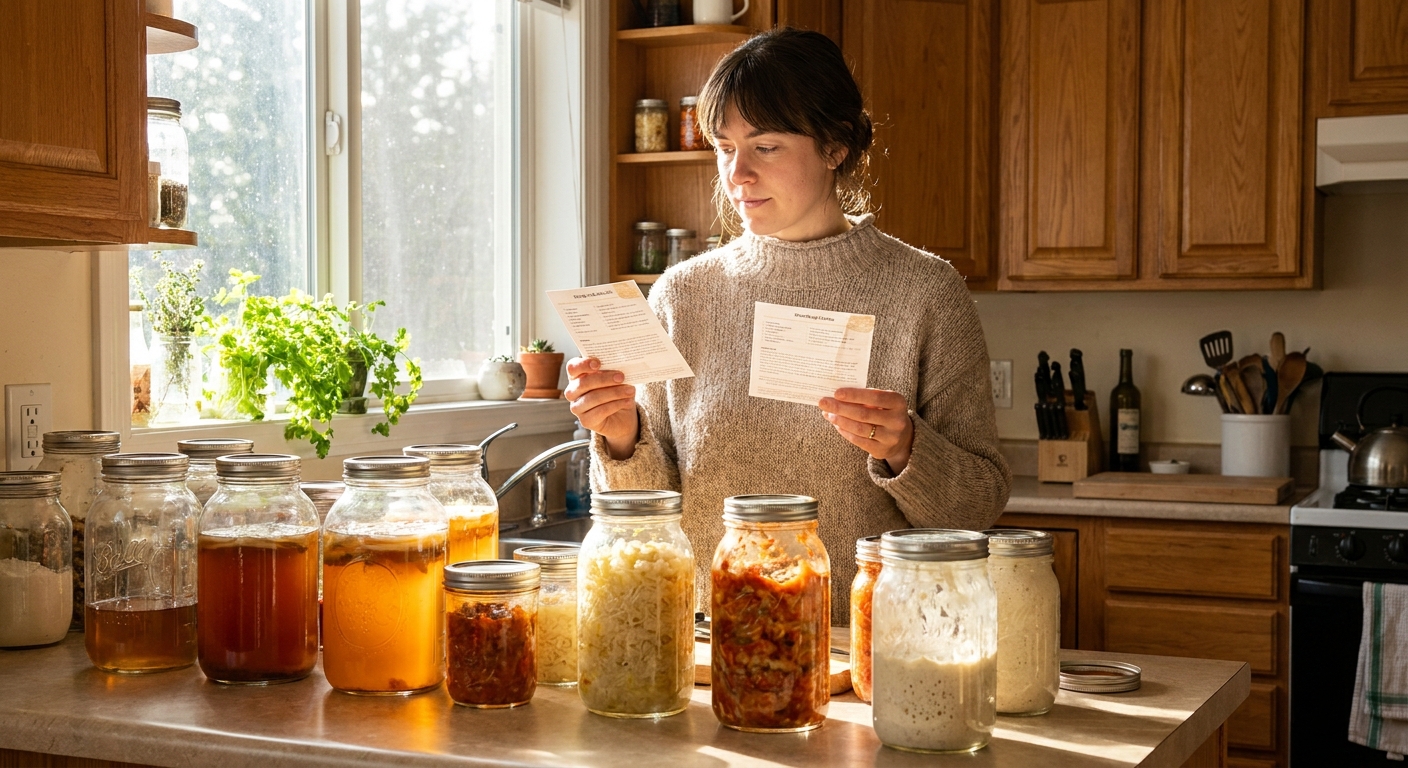
If you’re just stepping into home fermentation, kombucha might be battling for counter space with sourdough, water kefir, or yogurt. They all use microbes, they all bubble or thicken—but they behave differently in your kitchen.
Why Compare Kombucha to Other Ferments?
Let’s compare kombucha with a few popular ferments so you can decide:
- Where to start
- How to manage your time
- Which ferment fits your habits and taste
We’ll stay practical, but we’ll also talk microbiology so you understand why each project behaves the way it does.
The Contenders at a Glance
We’ll look at:
- Kombucha
- Water kefir
- Milk kefir
- Yogurt
- Sourdough starter
- Sauerkraut (as a simple vegetable ferment)
Kombucha: Tea, SCOBY, and Patience
What it is:
Sweet tea fermented by a SCOBY (symbiotic culture of bacteria and yeast).
Main microbes:
- Yeasts: produce alcohol and CO₂
- Acetic acid bacteria: convert alcohol to organic acids
Hands-on steps:
- Brew sweet tea.
- Cool, add SCOBY and starter tea.
- Ferment 7–14 days.
- Optionally bottle with fruit for 1–5 days.
Time profile:
- Active work: 30–45 minutes per batch
- Waiting: 1–3 weeks depending on F1 + F2
- You like tart, sparkling drinks.
- You can check on something once or twice a week.
- You enjoy experimenting with flavors.
- Needs consistent room temp and some space.
- SCOBY care between batches.
Best for you if:
Challenges:
Water Kefir: Fast, Fizzy, and Sensitive
What it is:
Sugar-water (sometimes with a bit of fruit) fermented by water kefir grains—gel-like clusters of bacteria and yeast.
Main microbes:
- Lactic acid bacteria (e.g., Lactobacillus)
- Various yeasts
Hands-on steps:
- Dissolve sugar in water.
- Add water kefir grains.
- Ferment 24–48 hours.
- Strain and optionally flavor for a second ferment.
Time profile:
- Active work: 10–20 minutes every 1–2 days
- Waiting: short cycles, quick gratification
- You want a fun, fizzy drink but don’t love vinegar tang.
- You’re okay with a daily or every-other-day routine.
- Your kitchen runs warm enough for rapid ferments.
- Easy to neglect (over-ferment) if your schedule is unpredictable.
- Grains multiply quickly; you must share or pause.
- Faster turnaround, milder acidity.
- Requires more frequent attention.
- Less tolerant of irregular schedules.
Best for you if:
Challenges:
Compared to kombucha:
Milk Kefir: Daily Drinkable Yogurt
What it is:
Milk fermented by kefir grains (different from water kefir grains) into a tangy, pourable probiotic dairy drink.
Main microbes:
- Lactic acid bacteria
- Yeasts
Hands-on steps:
- Add kefir grains to milk.
- Ferment 12–24 hours at room temp.
- Strain, refrigerate, repeat.
Time profile:
- Active work: 10–15 minutes per day
- Waiting: hours, not days
- You consume dairy regularly.
- You want something to use in smoothies, overnight oats, etc.
- You enjoy a daily, low-effort ritual.
- Needs near-daily attention.
- Must manage grain growth.
- Much faster cycle.
- More like a “pet that needs daily feeding.”
- No big jars of tea; instead, jugs of milk.
Best for you if:
Challenges:
Compared to kombucha:
Yogurt: Set-and-Forget (for a Day)
What it is:
Milk inoculated with specific yogurt cultures, held warm until it thickens.
Main microbes:
- Lactic acid bacteria (e.g., Lactobacillus delbrueckii, Streptococcus thermophilus)
Hands-on steps:
- Heat milk (typically 82–85°C / 180–185°F) then cool to ~43–45°C / 110–113°F.
- Stir in a spoonful of live yogurt.
- Incubate warm 6–12 hours (thermos, yogurt maker, or warm oven light).
- Chill and eat.
Time profile:
- Active work: 30–40 minutes
- Waiting: 6–12 hours
- You want big batches you can ignore for a week.
- You don’t mind a one-time heating step.
- Needs temperature control during incubation.
- Slightly more technical heating/cooling step.
- Faster total cycle.
- More temperature-sensitive during incubation, but then completely stable in the fridge.
- No ongoing culture “pet” if you just use store yogurt as starter occasionally.
Best for you if:
Challenges:
Compared to kombucha:
Sourdough Starter: Bread’s Fermented Heart
What it is:
Flour and water colonized by wild yeasts and lactic acid bacteria, used to leaven bread.
Main microbes:
- Wild yeasts (e.g., Saccharomyces, Candida)
- Lactic acid bacteria (e.g., Lactobacillus species)
Hands-on steps (maintenance):
- Feed starter with fresh flour and water.
- Let it rise.
- Use some for baking, save some, repeat.
Time profile:
- For regular bakers: 5–10 minutes per day or every few days.
- For occasional bakers: feed weekly and store in the fridge.
- You’re excited to bake bread.
- You like watching dough rise and bubble.
- You enjoy a longer, multi-step project.
- Timing baking around starter activity.
- Potential guilt about discard if not baking often.
- Similar concept (wild microbes in a stable culture) but used for baking instead of drinking.
- Requires baking time and oven; kombucha only needs bottles and room temp.
Best for you if:
Challenges:
Compared to kombucha:
Sauerkraut: Chop, Salt, and Forget (Mostly)
What it is:
Cabbage fermented in its own juices with salt, creating a tangy, crunchy condiment.
Main microbes:
- Naturally occurring lactic acid bacteria on the cabbage
Hands-on steps:
- Shred cabbage.
- Add 2–2.5% salt by weight.
- Massage until juicy, pack in a jar under its brine.
- Ferment 1–4 weeks.
Time profile:
- Active work: 30–60 minutes upfront
- Waiting: 1–4+ weeks mostly hands-off
- You like savory, tangy foods.
- You want one big weekend project instead of ongoing work.
- Getting comfortable with surface yeast (kahm) versus mold.
- Finding fridge space for finished jars.
- Similar long ferment timeline, but truly low maintenance once packed.
- No daily or weekly “feeding”—just occasional checking.
Best for you if:
Challenges:
Compared to kombucha:
Side-by-Side: Commitment, Flavor, and Risk
Time & Attention Scale (1 = low, 5 = high)
- Kombucha: 3 (weekly attention)
- Water kefir: 4 (every day or two)
- Milk kefir: 4–5 (daily)
- Yogurt: 2 (batch day, then done)
- Sourdough: 3–4 (depends on baking schedule)
- Sauerkraut: 1–2 (mostly hands-off)
Flavor Profile Comparison
- Kombucha: Tea-forward, tart, lightly vinegary, easily flavored fruity or herbal.
- Water kefir: Lightly sweet, often fruity, less acidic.
- Milk kefir: Tangy, creamy, sometimes effervescent.
- Yogurt: Mild to tangy, thick, dairy-based.
- Sourdough: Bread aroma, mild lactic tang in finished loaves.
- Sauerkraut: Salty, tangy, crunchy, savory.
Equipment Needs
- Kombucha: Large glass jar, bottles, SCOBY.
- Water kefir: Jars, grains, breathable cover, bottles.
- Milk kefir: Jar, grains, strainer.
- Yogurt: Pot, thermometer helpful, warm incubation method.
- Sourdough: Jar, flour, scale helpful.
- Sauerkraut: Knife, bowl, jars or crock.
Microbiology: Why These Ferments Behave Differently
Oxygen vs No Oxygen
- Kombucha, water kefir, and sauerkraut begin with exposed or semi-exposed fermentation:
- Kombucha: needs oxygen at the surface for acetic acid bacteria.
- Sauerkraut: packed anaerobically, but top layer sees some air.
- Yogurt, milk kefir, and sourdough prefer more limited oxygen, relying heavily on lactic acid bacteria and yeasts adapted to dense environments.
- Why kombucha develops a SCOBY (bacteria building cellulose at the air-liquid interface).
- Why sauerkraut needs cabbage submerged (anaerobic brine protects it).
This oxygen difference explains:
Sugar vs Starch vs Lactose
- Kombucha & water kefir: microbes feast on sucrose, glucose, fructose.
- Milk kefir & yogurt: microbes digest lactose in milk.
- Sourdough: microbes digest starches broken into simpler sugars in flour.
- Sauerkraut: microbes digest vegetable carbohydrates and fibers.
Matching the right microbes to the right food source is why you can’t simply swap cultures—your kombucha SCOBY doesn’t know what to do in plain flour, and yogurt bacteria won’t reliably ferment tea.
Choosing Your First (or Next) Ferment
Start with Kombucha If:
- You drink soda or sparkling beverages and want a homemade alternative.
- You like checking on a project a couple of times per week.
- You enjoy the idea of evolving flavors over weeks.
Start with Sauerkraut If:
- You want maximum reward for one afternoon’s work.
- You prefer savory ferments.
- Your schedule is unpredictable.
Start with Yogurt If:
- Your household goes through a lot of yogurt.
- You prefer a one-day project you can repeat when needed.
Add Water or Milk Kefir Later If:
- You’re comfortable with daily or near-daily tasks.
- You’d like a quickly rotating probiotic drink.
Try Sourdough When:
- You’re ready to bake and can commit to a few feedings per week.
- You like tangible, edible proof of fermentation in the form of bread.
Running Kombucha Alongside Other Ferments
Can you keep more than one ferment going at once? Yes—with a little planning.
Basic Coexistence Rules
Physical separation:
Keep jars a bit apart so yeasts and bacteria from one don’t dominate another. A few feet is usually fine.
Odor control:
Don’t ferment strongly scented things (like kimchi) right next to kombucha. Aromas can creep.
Scheduling:
Stagger your projects so you’re not bottling kombucha, feeding sourdough, and straining kefir all at the exact same time—unless you enjoy a very busy kitchen day.
Example Low-Stress Setup
- Kombucha: Start a new batch every 7–10 days.
- Sauerkraut: Make one or two jars once a month.
- Yogurt: Make a big batch every 2 weeks.
This gives you plenty of fermented diversity without daily obligations.
Final Thoughts: Let Your Habits Lead Your Ferments
The “best” first ferment isn’t the trendiest one—it’s the one that fits:
- Your taste (sweet, tart, savory, creamy?)
- Your schedule (daily, weekly, monthly?)
- Your space and tools
Kombucha sits in a sweet middle ground: not as needy as kefir, more dynamic than yogurt, and endlessly customizable. If you like the idea of checking a jar, tasting, adjusting, and watching a SCOBY slowly thicken like a science project you can drink, it’s a strong starter choice.
And once you’re comfortable managing a SCOBY and timing your ferments, adding a crock of sauerkraut or a jar of sourdough starter will feel like a natural next step—not an extra burden.